Make Beautiful Music

Last night I dreamed that I was getting married. My female relatives, young and old, were gathered all around me. It was a consummate summer scene in a fragrant apple orchard with vivid green grass and brilliant blue sky.

Instead of a frothy veil, I wore a simple crown of daisies in my hair. This crown was just like the one I had braided in my kitchen from a bouquet of Stop & Shop daisies shortly before I was married nearly forty-three years ago. This time there was no groom to be seen.

I innately knew that this marriage was mine alone.

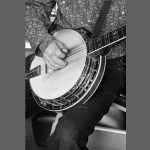
I watched my sister approach carrying a banjo, in spite of the fact that she has never played a musical instrument.

She handed the banjo to me, in spite of the fact that I also have never played a musical instrument.

I sat down with this instrument in the midst of the wedding guests and looked down at the fretboard that crossed my lap. It was a light-colored wood that made me think of birch forests. Or maybe aspen.make beautiful music

I tentatively strummed across its taut nylon strings with my thumb, and was surprised to hear amazing music, so I continued to play. I played as if I knew what I were doing and the music kept coming, clear and beautiful.

The relatives moved in closer, surprised at my sudden talent.

And then it was gone.


I think that my dream means that sometimes we underestimate our abilities and our capacity for creating our own joy.

The banjo is a less respected instrument than guitars and violins and cellos, but it’s capable of beautiful music. Just because we’re different doesn’t mean that we can’t be beautiful.

This year, embrace your uniqueness and your dreams of the future. Don’t depend on anyone else to get you there or you may find yourself disappointed.

You and your path, like the banjo, might be uncommon, but they’re no Linda Summersealess deserving of success. You can get there on your own. I know you can.

Happy New Year.


make beautiful music

Follow me on Facebook.

Write from Passion. Write from Pain.

When I began writing my memoir, it was a bonfire burning brightly, my fingertips hot on a keyboard that had never revealed my thoughts or memories. To anyone. I looked down upon my small-child-self from a bird’s eye view, flying low, watching the small child whose introversion was created by responsibilities and fear.

The small child ran and ran, never getting away, and the story ignited.

It burned tall as the trees, like the annual winter brush-burning that took place in our woodlot. We pulled scorched potatoes and sweet corn in twists of aluminum foil from the ashes and ate them greedily while setting fire to yet another pile of scrub.

The writing has been like that. I have grasped the fiery memories, explored the value of what stays and what goes. Yet even after several front to back revisions, and a chronologically accurate piece, I still didn’t feel comfortable that it was done. Whole. Meaningful.

It was accurate in a literal sense, but the pulse beneath the outward story was lacking.

I kept looking for guidance and have finally found it in the opportunity to study my work and the work of seven other writers meeting weekly since August.


I began what I’m now thinking of as a “Misfit’s Holiday”, taking the train down to Portland on Tuesdays and returning on Wednesdays after a manuscript class with Lidia Yuknavitch and a sound night’s sleep in the bunk room at The Society Hotel (Seattle Times: “Hotel Hip”).

We’ve met eight times with four to go, and man, I have grown!

The class series is called The Body of the Book and involves going deeper, going Corporeal, Lidia’s unique approach to teaching writing. It’s for eight writers who dare to go beyond the traditional critique models to “engage in collaborative art making.” (from Corporeal Writing)

As it says in the course description, after acceptance, participants agree to commit to “helping one another see the patterns at work in their material, helping them hunt for hidden metaphors, pointing out distinct rhythms and repetition and images, and supporting the writers in daring to develop them further, in the ways that other workshops insist on plot, narrative, and action.”

In a sense we are sharing the role of teaching and I dare say that, with Lidia as our teacher facilitator, it has clicked for all of us. After about four weeks, we were all in the groove, seeing those patterns in our own work as we saw them in each other’s, and you could see the growth in our pages. For me, it was the eighth week that was the bombshell.

I had set up a spreadsheet where I transcribed the notes from my peers for each chapter, so that I could go back and take another look at my work.

Bingo. Some hidden memories blasted to the surface. Other chapters fell out of the manuscript, no longer necessary to the overall story. My language evolved, advanced, grew. Paragraphs moved, watery chapters thickened.

Eight weeks in, I have nearly 30,000 words revised. Along with reading and critiquing 90 pages of my fellow students’ work per week, it’s a big task to tuck this into a life being lived.

I’ve been staying up till midnight—no— till one, till two in the morning—not wanting to close the lid on my laptop, and often remembering a better way to say something as I fall asleep, then sitting up to quickly note it before it disappears on the back of my eyelids.

Most importantly, I’ve gone full frontal “corporeal, in the body” in this revision and I’ve regained my writer confidence.

writingI suppose it’s not a coincidence that Lidia’s  The Misfit’s Manifesto launched this past week at Powell’s City of Books. My fellow misfits and I sat together front and center, knowing that we shared a special secret.
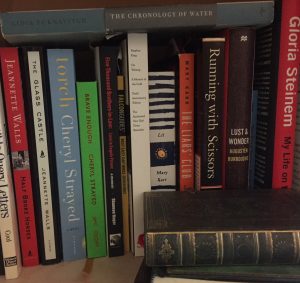
I can’t wait for Tuesday.


writing


Like me, Follow me.

Writing the Body of the Book

Every morning I brew Folgers-nothing-fancy in my headboard bookcase so that I can begin writing fresh from my dreams. Pajamas or nearly naked, depending on the season. Darkness or daylight, depending on the moon. Before I feed my dog and cats. Before I rummage in the pantry for breakfast in bed. Before the bald eagle flies low over the water outside my window… and he just this moment did...right on schedule. The white of his head and tail feathers so purely bright bright bright. I sigh. Every time.

For the past five weeks, I have written nothing new, other than a few watered down Facebook posts and I’ve not shared the reason. Till now.

At some point a writer needs to leave one’s nest and face criticism. Critique criticism, not you-bad-bad-girl criticism.

During the summer, I subscribed to Lidia Yuknavitch’s mailing list and, heck—I couldn’t believe it—that very same day I received a message that applications were open for her The Body of the Book workshop, where eight writers with unpublished manuscripts would meet for twelve Tuesday evenings to provide feedback and support. Not trite feedback-and-support but real, committed, feedback-that-feeds-support.

Omigosh. I began work on my application immediately. Cut to the chase. I was accepted.

I’ve been taking the train to Portland every Tuesday, booking into a wonderful little hotel that began as a sailors’ lodge in 1881. I’m loving the fifty-bucks-a-night coed hostel-style bunkroom. On the first day, the twenty-something clerk asked if I wanted her to show me how the key card worked. (WTF. Exclamation point. Yeah. I blanched. I blinked. But I simply said “no”. Ageism?? God bless me when I finally let my hair go grey. But nevermind. It’s a great place and at some point I guess I have to share that our brain cells don’t blink out like fireflies once we turn 65.)

The class is all positive good stuff, all inspiration, all writerly comradery. Warm, hot, winey, and most of all, a safe space and politics aside, although we all share the same politics. Politics: the process of making decisions applying to all members of each group.

When we were accepted, we committed to bringing everything we’ve got to the other members in the group. Feedback and opportunity. Ninety new pages to think hard on each week. Pure responses.

So that’s what I’ve been up to.

We’re midway through the process.

I’m going to miss these brilliant woman and their stories when it’s over, but for now, I’m going to continue to respond with the same fervor that I appreciate from others.

As if that isn’t enough good stuff, it’s harvest season. When I return home, it’s blackberry jam, pickled beets, zucchini relish, homemade blackberry brandy fermenting in the downstairs closet, tomato sauce simmering on the stove, a lovely chunk of brisket brining in the refrigerator for my homemade pastrami.

It doesn’t get any better. Growing, nurturing and harvesting stories. Feeding our souls and our bodies.


Follow me on Facebook.

Thanks!

Willpower

Willpower is not my strong suit. It’s not my weakest weakness, but I could do better. What are the biggest weaknesses in my willpower folder?

Writing and Reading.

Writing should not be an issue for a writer. When I get these ideas in the middle of the night, when I awaken with my teeth clenched in my mouthguard and my eye mask askew, my hands shaking with the visage of the ethereal nightmare that I’m watching grow smaller and smaller as it drifts out the window, lifting up into the naked branches of the cherry tree, and beyond, into the clear clear clear dark sky, I reach for my laptop.

I open a Word doc and type the sentence I want to remember, the sentence that will fuel my message later. Much later. I have too many writing prompts on too many topics.

But Reading. That’s my biggest downfall, my Achilles’ heel.

I am constantly finding one thing after the other to read online! (Exclamation points are another weakness but I have almost conquered that one, and you’ll note that the previous exclamation point is warranted!.)

“The anatomical basis of Achilles’s death is more likely to have been injury to his posterior tibial artery behind the medial malleolus, in between the tendons of the flexor digitorum longus and the posterior tibial vein. This area would have been included in Thetis‘s grip.” See what I mean? I’m pathetic.

The New Yorker tells me that I’ve hit the wall. I’ve read all the free articles they’re going to allow me. “Subscribe for $1 a week and get a tote.” I have too many totes, but I very nearly do it. I fear that if I subscribe to one, the rest will follow like literary dominoes. The Wall St. Journal, The Washington Post. Like the 12 Temptations of Christ, they’re calling out to me from their individual browser windows until I have filled way too many hours of my day with an endless loop of reading.

The New York Times is a deep bottomless pit of content. Yes, I do subscribe to The New York Times, digital edition, so it’s my own fault. I had been a faithful print subscriber to The Wall Street Journal for years, and then, damn it, the he/she faceless, anonymous paper delivery person kept forgetting (even when I left notes) that on Wednesdays, if he/she left my Wall St. Journal in the Beachcomber tube, the weekly Beachcomber would not be delivered. They penalize us like that. (Fair enough.)

I finally had enough of occasionally missing out on Wednesday’s local news, obits and the Calendar. I called The Wall St. Journal and told the man in India about the tube that the he/she, faceless, anonymous paper delivery person was hijacking everyday and, with unfortunate results, on Wednesday’s. “I would like to cancel my subscription.”

I would miss Dan Neil, the automotive columnist, whose blend of wit and mechanical knowledge is quite attractive to me. I wouldn’t miss the $5000 Gucci handbags in the monthly magazine section. I wouldn’t miss the Financial pages because I never read the Financial pages. I wouldn’t miss that humor guy whose pieces appear in the lower right spread “below the fold” on the Opinion page. (Below the fold is where they put the lesser content.) I can’t remember his name, but I sincerely believe that I could write a humor piece as good as he. (And don’t tell me it’s “as good as him”. When did the world switch from “he” to “him” in this context? It’s everywhere. Don’t they read Grammar Girl?)

Here I go again, off an another reading tangent. I googled* “Wall St Journal opinion page humorist” and after Peggy Noonan (!) I find a list of Top Humorists. Stephen King is #1 on this list. Joan Collins is #3. What? Art Buchwald, my childhood idol (You think I’m joking?) is #7. Tsk.

The man in India asked if I would keep my subscription if he directed the he/she, faceless, anonymous paper delivery person to install a proper tube for The Wall St. Journal. Like a good customer service rep, he diffused my annoyance and I agreed to allow 2 weeks for the tube to be installed.

I waited 4 weeks. Still no tube, and yet another lost Beachcomber issue. I called and there was no distracting me this time. I cancelled my subscription and went online to subscribe to The New York Times. I’m sure that Rupert Murdoch is not going to miss my $99 per half year.

Now I’m reading a whole new litany of favorite columns. Modern Love is best. I crave warmth like the Pillsbury Doughboy.

Facebook is my love/hate relationship. Why does someone have to ask a question of their readers that I feel responsible to answer?

This morning a fellow writer, a friend, who is writing a novel set in the time of Boccacio, posted “Who can tell me what the paste left after the oil is pressed from olives is called in Italian? In medieval times, it was a treatment for arthritis and joint pain.”

I responded,
“No, I cannot. However, thanks to your question and my lack of self-control with Google, I now know more than I need to about olives— production, harvest and economics!”

I’m incorrigible.

I found a solution to my lack of willpower with respect to Reading online.

I decided that, beginning today, I shall unplug my laptop when I begin to read online. When the power percentage reaches 0% and my MacBook powers down, that’s it. Tough luck. I’ll have to proceed to the items on my “To Do” list.

Did it work? No. As soon as the pop-up warned me that I was at 5%, I ran for the charger. I needed to finish “How Weed Got Me in the Best Shape of My Life”. What? I don’t need weed to exercise. But I was curious. This is Washington state, after all.

I should note that the day after I cancelled my Wall St. Journal subscription, I found that a shiny new Wall St. Journal tube was in place at the end of my driveway with the morning’s issue.

The very next day, it was unceremoniously removed.


*Is the verb “google” upper case or lower case? When I google it, I get everything to do with the search engine and nothing to do with the verb. 😉

Like me on Facebook.

Read more stuff.

Inspired by The New Yorker. Writer needs forever home. Adoption listing.

Linda Summersea May 2016Meet Linda. She came to us with a BFA and MFA, but sadly, these degrees were not in Creative Writing. Her shame for advanced degrees in a field outside of writing has left her cowering in self-doubt but she no longer piddles when addressed in a loud voice and rarely bites back—providing she is given lots of affection. As she is of advanced age, we have been having a difficult time placing her in a tolerant environment where she can thrive. Although easily distracted Linda can be kept on task with black coffee and BoomChickaPop. She benefits from a long walk every day, preferably in the shade of a forest with someone who is open to discussing writing prompts. In the past, Linda has run off to foreign countries without warning and been difficult to locate. She has recently been micro-chipped. Problem solved. Linda’s current wardrobe is almost entirely black, but since she responds well to tie-dyed garments, we’re hoping to add other colored garments in the near future. Linda would do best in a one-writer home with access to a hot tub.


I wish I could say that the topic of writer-as-pet-needing-forever-home was my own brilliant idea. Alas, Sarah Hutto beat me to it. Read her hysterical piece Writers Looking for Forever Homes here in The New Yorker. And thanks to Seattle writer Camela Thompson for the heads up. It made my day. Still laughing.

Are you a writer? Surely you are now opening a Word doc to pen your own adoption listing.


New YorkerFollow me on Facebook or I’ll bite you.

Meditation on One’s Calling

Clearly, for me, May has been a month of false starts and unfinished business, crossroads, and decision-making. Let’s try this blog post again. 🙂


Every Friday morning, I park my vehicle under a large Kwanzan cherry tree in a parking lot a couple blocks away from the Senior Center. With its fragrant double blossoms, it’s the kind of exemplary cherry tree that we associate with cherry blossom festivals in the Spring.

Two weeks ago its petals were drifting down to the pavement in flurries so thick it was accumulating like snow. Moist and slippery. And beautiful.

I was on my way to my weekly Guided Meditation Class.

I was thinking about earth—dirt, soil, compost, all of the above. I had spent a month that was more outdoors than in. I had been walking the earth, digging in the earth and thinking about digging in the earth, in the sun and in the shade, in the brutal heat and the cool rain.

#

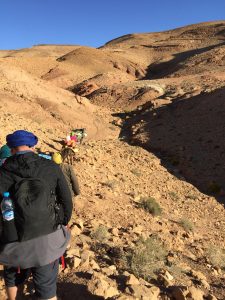
I had begun April walking with Berber nomads from the desert plains to the Atlas mountains of Morocco, where the earth and the air were dry as toast. For a week, our international group of twelve were an active part of the nomadic experience 24/7.

Atlas Mountains, Morocco, April 2017.


No running water save for one lively spring that poured  from a crack in the upthrust rocks on day 2. No conveniences of any sort, and millions—billions—of brilliant pinpricks of stars above by the time I slid into my sleeping bag in a new location each night. Intimately connected to the earth, with only the occasional bleating of sheep and goats breaking the silence.

When I returned, I spent a week transitioning back to modern life and crawling around in my damp gardens, thinning, transplanting, and weeding in preparation for another couple of weeks away in the outdoors.

I set out again, hiking the woods and hills in the Berkshires Mountains of western Massachusetts, enjoying “carpe diem” moments to continue the hiking momentum that had dominated my days in North Africa. Again, I hiked for hours without even noticing the time.

I found myself drawn to the trails where my literary heroes had walked, some of these trails now part of the Appalachian Trail. Went to the farm of Herman Melville and walked in his woods, climbing over fallen trees, and standing beside gardens that were still half-asleep after a long, stormy winter.

On one particularly unseasonably warm day, I climbed Monument Mountain where Melville and his friends had enjoyed these same views after a sweaty hike through mature deciduous woods scattered with the rocky remains of boulders tossed there during the Ice Age ten-thousand years ago.

Drove down to Amherst to Emily Dickinson’s home. Looked out the window from her second-floor bedroom, more gardens, more inspiration.

#

All of those experiences were uppermost in my mind on my way to meditation class that Friday morning.

Our theme that day: What do I have that I can share with the world?

We began with deep breaths in and deep breaths out. 4 seconds in, 4 seconds out. Belly breaths. By the time we reached the completion of our meditation, I was 8 seconds in, 11 seconds out. A new level of relaxation for me.

When I opened my eyes, I had my answer to the theme.

#

“Sharing my truth” is my answer. It’s been my goal for the past few years. I had dug deep into shrouded memories to write my childhood memoir after a long career as a teacher. I thought those years of teaching had (almost) been fruitless. I knew I had affected lives here and there, as most teachers do, and I had felt the reciprocal effects of my students’ lives as they taught me their life lessons. But teaching was not the career I had longed for as a child. I wanted to write, and it was a great relief when I realized later in life that it wasn’t too late.

#

Two days ago, our meditation theme was a variation on our earlier “sharing”.  What was “our purpose” or “our calling”in life?

Suddenly I remembered the words of a school principal during one of my annual job assessments. She told me that true teachers are born, not made, and that I was a natural-born teacher.

During Friday’s meditation, those words suddenly came back to me and I understood that all those years of teaching were not for naught.

I now see that there’s a connection between my previous life’s work and my current life’s work. With my writing, I hope to, want to, will continue to teach, but on a different scale and in a different format. No longer one to one, or one to thirty, writing has the ability to be one to infinity. As a writer, our work and inspiration can carry on long after we are gone.

What is your calling? your purpose?


meditating, meditation

Follow me on Facebook.

American Writers Museum

american writers museumToday is opening day at The American Writers Museum in Chicago IL.

Actually I didn’t even know that it was being assembled until page A13 in this morning’s Wall Street Journal.

According to the review by Edward Rothstein (Critic At Large), the AWM has been created at a “sensible” cost of under $10 million: its 11,000 sq. ft. are housed on the second floor of an office building at 180 N. Michigan Avenue, Chicago, IL 60601.

Since I haven’t visited, I can’t very well make this a review within a review, but I do think the concept of a writers museum sounds pretty admirable. Of course, as a writer myself, I found myself questioning the punctuation of its name. Should it be American Writers’ (possessive apostrophe) Museum?

No, I guess not. It’s not owned by writers, they don’t possess it, so it can hardly be possessive. It’s not even for writers, as one doesn’t go there to learn writing. It’s best described as a museum for readers (Rothstein says that “an earlier era’s powerful American writers’ museums were called libraries.”)

Mr. Rothstein, for the record, says “I wanted to like the result much more than I actually do.” The fact that his review is entitled “A Cliffs Notes Approach to Literature” hints at his opinion so I dug in. The accompanying WSJ image shows The American Voices exhibit of 100 (dead) writers. Rothstein finds a lot to critique/criticize.

Again, I’ll not quote his lukewarm response to the finished result. It seems to me that his review hints at his personal dilemma. He weighs the better and lesser points of the museum. I could picture him walking around saying “…hmm.” On the plus side, Rothstein does say that the AWM was “put together with care and designed with panache by Andrew Anway”. And FYI, The American Writer Museum is “the brainchild of Malcolm O’Hagan, a retired engineer who, after seeing the Dublin Writers Museum, was determined to build one like it here.”

I could say something about Americans not revering their writers quite as much as the Irish. However, that might be debatable.

After reading the Rothstein review, I sought out the AWM website. They have a lot to share at the museum, and a lot of it is interactive.  There are a many events lined up, including writer readings and signings. Ha! I guess we all know what the newest writer coup will be.

My favorite page is their Affiliates list: The Museums/Writer Homes officially affiliated with them. A long list is it. A bucket list, to be sure.

My second favorite is the home page because my favorite deceased author, Herman Melville, is featured dead center—I mean, “front and center”.

Checking out some other reviews online:

Amy Diegelman for BookRiot calls it “Chicago’s New Literary Paradise”.

The Chicago Tribune’s reporter Steve Johnson calls it “far-reaching, dramatic”.

The Washington Independent Review of Books tells the story of the museum’s inception in this 2012 article.

It’ll be a while before I get to Chicago. In the meantime, if you visit The American Writers Museum, we’d love to have you share your impression here.


american writer museumI’d love it if you’ll follow me on Facebook.

C’mon, you know you want to. 😉

Writing, Breathing, Thinking

Writing, breathing, thinking—emphasis on “thinking”, and not necessarily in that order—are the essential elements of a writer’s waking hours.

Lately I’ve been filling out Writer Residency applications, and this especially leads me to a lot of thinking about writing and why I write. I look at the notes—my notes, my opinions—that I’ve written in the spreadsheet columns of my previous year’s application records.
“Terrible artist statement.” “Decent project description.”
I don’t shy away from the failures. They’re mostly failures. I keep trying to improve.

I couldn’t stop writing now if I tried.

And like the old shampoo bottle adage of the 60s, “lather, rinse, repeat,” with each round of applications, I examine myself closer and closer, not looking for flaws—because that’s easy—but instead, looking for my strengths. We can write in our garret or vacuum or basement or bedroom, but no one will ever know what we have to share unless we can convey our strengths to the gatekeepers of the publishing world.

So we keep going, and we try to express it better, stronger.

When I awaken, whether it’s at 4:30 or 6:30 or somewhere in between, I reach for my laptop and my coffee, and get to work.

I couldn’t stop writing now if I tried.

When I gave myself permission to write my childhood memoir, when I unlocked the door to my deepest memories, everything poured out like the Flood of ’55 in New England. I saw the good memories and silly memories bobbing in the dark water, carried along under grey skies, the fears and fantasies, everything moving past, fast and faster. I could barely keep up. I typed as fast as I could, sometimes dropping single words into a parallel document because I was afraid of losing the memories as the momentum grew.

I couldn’t stop writing now if I tried.

I mostly write about what’s inside of me. Who would have thought that we could keep thinking for this many years and have all of those thoughts piling up inside our brains, indiscriminately filling cell after cell with content?

I couldn’t stop writing now if I tried.


writing, breathingFollow me on Facebook.

Find Your Past in Your Present

It has not been an easy month.

I noticed this morning that I have seventeen unfinished drafts of blog posts. Four of them were written in the last thirty days. There they sit, waiting for another day.

On the bright side, I also noticed that when I least expect it, I find a relevant moment in my present life that takes me back to my past.

This week that moment came in the form of recurring scenes in the film Paterson.

Paterson is about a bus driver named Paterson, who happens to drive his bus in Paterson NJ. He’s also a poet, and we watch him repeat his daily pattern over and over with subtle differences.

IMDb describes the film as “A quiet observation of the triumphs and defeats of daily life, along with the poetry evident in its smallest details”.

I can’t imagine a better description. Paterson leads, I think, a zen existence. Even though Paterson’s daily life takes place in the present day, you find yourself easing out of the digital age to a quieter rhythm of existence. Your pulse slows.

This is not to say that the film is slow, although, yes, a moviegoer used to high flash action will certainly be fidgeting. In fact, many people will find it slow, but its strength is in that quiet rhythm, and that quiet rhythm might be the reason for its many nominations and awards*.

So—what was it about Paterson that took me back?

The Lunch Box.

patersonPaterson carried a lunch box to work every day that was exactly like the black lunch box with the thermos in the cover that my father carried to the factory, day after day, month after month, year after year.

It was the same lunch box that millions of other factory workers in the 50s carried to work. Even Ralph Kramden, the bus driver played by Jackie Gleason in the iconic television series The Honeymooners, carried the same lunch box.

As I watched Paterson sitting on a park bench with his open, and neatly packed, lunch box beside him, it made me realize that I never—throughout my entire childhood at home—ever saw the contents of the lunch box that sat on the counter next to mine each morning before we set out for school and work.

I knew that every day of my grammar school years, my own lunch box held a peanut butter and grape jelly sandwich on squishy white not-Wonder bread, a thermos of warm Kool-aid, and—if I was lucky—two or three small oatmeal cookies. Sometimes I found a fleshy single slice bologna sandwich, but after two or three bites that stuck to the roof of my mouth, I dropped it in the wastebasket along with its waxed paper wrapping.

During the writing of my memoir, I spent the past three years mentally reviewing as much of my childhood as I could muster up, so I had to laugh this week at the lunch box question.

What did Daddy eat for lunch?

I haven’t the fainted idea.

Whatever it was, he must have found it acceptable because I don’t remember him complaining about it—and he complained about a lot.

Every day he returned the lunch box to its place next to the sink’s drainboard and every morning he picked it up before setting out.

It’s odd that in replaying my childhood like a staticky 8mm film on the screen inside my head, I never once saw The Lunch Box.

What else have I missed?


One more thing:

Paterson ends with an event that reinforced another part of my present. No spoilers here, but the meaning—I believe—is that a writer has to write. There is no other choice.


*Boston Society of Film Critics Awards, 2nd place, Best Screenplay. Boston Online Film Critics Association Awards, 4th place, Ten Best Films of the Year. Dublin Film Critics Awards, 6th Place, Best Film.  Adam Driver (Paterson) was nominated several times for Best Actor and won at least two: Toronto Film Critics Awards, Best Actor. Los Angeles Film Critics Association Awards, Best Actor.

Follow me on Facebook.


How to Tell a Damn Good Story

Pat Conroy said, “The most powerful words in English are ‘tell me a story.'”

Imagine our ancestors sitting around the glowing embers of a dying fire, the fire reflected in their eyes, their rapt attention inspiring the storyteller to go deeper and deeper still.

Storytelling surely has instinct and intensity in primal roots and gut feelings.

Storytelling is personal. It’s emotional. It’s a connection.

So how do you make it work for you, the writer, and for them, the listeners?


I told a story last weekend during Lit(erature) Lounge, a storytelling event at The Open Space for Arts & Community. I must admit that what I enjoy most is that moment when the room goes pin drop quiet and mouths fall open as ears tighten and focus on the content that’s flowing over the crowd. This moment is a rush for the storyteller because you know that you’ve caught the attention of your audience.

They’re not going anywhere. They’re not getting up to get a glass of wine. They’re not heading to the rest room. They’re not checking their iPhone. It all can wait.


Whether your story is five minutes or a continuum the likes of Scheherazade, it continues to ebb and flow. It travels between the lips of the storyteller and those who have gathered to listen.

For me, that pin drop quiet creates a zen experience when the audience and I become one.  It emboldens me to connect with changes in volume and pacing, vocal style and very subtle body language, small gestures.

But—here’s the thing—storytelling should never be about ego. It always needs to be about sharing.

When you have the attention of the audience, your story needs to move them, to give them hope, teach them a lesson. It has to subtlely be about them, not you.

As Brook Warner of She Writes Press and Linda Joy Meyers of the National Association of Memoir Writers have shared in their lessons on what they call “takeaway”:  “Takeaway is the arrow that pierces the reader’s heart.”

Powerful, right?


So how do you do it successfully?

By helping the audience become part of the story, even as they listen without responding verbally.

By having a story arc with strong imagery.


When you were a child, it began with “Once upon a time…”

The protagonist (the main character—Cinderella or Gulliver or Bilbo Baggins) appears in a situation. Then, like in real life, stuff happens, everything goes to hell, and we watch them wiggle their way through to a satisfying ending.

Your storytelling has no stage set, no images, no costumes. Your words must create the scene and enable the listeners to become part of the experience. They create images in their minds by combining your words with their own history.

If you’re successful, your storytelling will provide the audience with something satisfying to gain.

They’ll lean in.

You’ll make eye contact. First one, then another, then another. And another. Your eyes will convey that you want them to know that this is their story.

You’re telling it for them.

You want them to feel the magic.


Write your story. Read it aloud to yourself, underlining the words that jump out in your diction.

Then go back and edit the page with a way to remind yourself of the words that need emphasis and the places where pauses are effective—essentially the pacing of your storytelling.

I like to use italics or bold print as cues to my verbal emphasis. Then practice your story on a friend or your writing circle.

Tighten up the story so that there are no points where the audience glazes over.


Have you ever noticed that when you’re given parameters for a written piece that are smaller than your written piece, you manage to cut out the chaff and the shorter piece is stronger?

Example: you want to submit a story to a publication or contest but the limit is 3000 words. Your story is 4000 words.

I’ve found that the challenge of shortening a piece of existing work always makes it better. That might be just me… I tend to go on… but I do think it’s applicable to most every writer.


So polish your story, make it relevant to the audience with takeaway. Make sure that it paints imagery as vividly as an artist’s brush. And not just visual imagery. Let them hear, and smell, your story too.


Then, when you step away from the mike, the spell will break with a snap. Your audience will have something to carry home, to muse over in later days.

If not, your storytelling is nothing more than a dark shadow on the wall of a cave.

storytelling


writing the nightmaresFollow me on Facebook.