Well, here we are…

…having crossed into the second month of 2021.

What do you think? Are we better off? Do we see positivity on the horizon? Are we feeling better? Healthier? Mentally more stable? Are you at work on any resolutions?

I’m just glad that I’m not toggling between CNN Live and MSNBC 24/7. Although I did appreciate and enjoy the content between 9 PM and midnight—that I had little previous exposure to.

I got my first COVID-19 vaccine innoculation this week. Whew.

I’ve been listening to more music. Mostly 60s and 70s material. Thinking about those times, and missing live music. Very much. No sense looking for 2021 Bands On Tour.

However, I’ve been taste-testing podcasts. Some that I had forgotten about.

Flowers are blooming here in the rain. Time to think about the garden. I decided to dig a 12″ deep trench, 2′ wide, 8′ long. Maybe tomorrow. I want to drop my compost bins into the ditch so the worms can get in through the slots.

Dieting. Semi-successfully. I’ve taken off my “Covid Nine” but am having a difficult time getting past it. Weighing my food and abstaining from alcohol. Boo.

Can’t resist flipping through details of wild places to visit in 2022.

Oh yeah… Definitely writing more and taking Restorative Yoga classes.

Hiking in the woods, alone with my thoughts. Lost. Not Lost. Beating back depression with a trekking pole.

Baby steps. Thumbs up! 🙂

Your Phobia, My Joy

This morning I was reading a piece in The New York Times about three friends embarking on a 7-day kayaking trip in the wilds of Alaska*. On Day 1, within minutes of being dropped off, a whale spouts offshore, close enough for gleeful joy or absolute fear—depending upon your response to large mammals in close proximity to you in the wild.

Two of the three took the sighting as a good omen. The other, who had once been surrounded by dolphins while scuba diving, went into panic mode.

I put the article aside and came here to think about it.

Isn’t it interesting how one person’s phobia can be another’s absolute joy? And, beyond that, how you can experience an event that causes a phobia, but then, through mind over matter, reshape your response to that event.

You can see where this is going. It reminded me of my siblings and me growing up on the farm.During the hot, dry summers of Massachusetts, the heat was periodically broken by magnificent thunderstorms. We could see them approaching in the distance.

The thunder—the louder the better. Let it rock the sky. I loved to hear it roll across the landscape. The lightning—let it draw maps of madness, etching veins of light bright as the stars in response to the thunder. My sister, on the other hand, was terrified, and still is, of thunder and lightning. I don’t know what caused the differences in our responses. My father always told us a cockamamie tale of Rip Van Winkle and his pals bowling tenpins in the sky. I stood before the south window, watching the storm wipe across the valley. My sister fled to her room with a pillow squished around her head.

For years, after a fall from an extension ladder, I was terrified of heights. The ladder stood in the stairwell of my parents’ home under construction when I was thirteen.

“After the carpenters went home for the day, my sister and I sometimes carried boardgames up the hill from the farm. We liked playing Monopoly and Scrabble in the shell of our future bedroom. We sat on the floor, our backs to the open 2×4 walls, playing in the bright light of the west sun as it crept lower in the sky until it was time to go home for supper.
Without a flight of stairs, the only access to our second floor bedroom was up and down the rungs of an aluminum extension ladder from the basement. The ladder rose from the basement floor, past the first floor, and stretched up past the second floor to lean against the open stairwell. Our parents didn’t express any safety concerns. Nor did the carpenters. No one did. Until the day I fell out of the sky.
“Falling out of the sky.”
That’s what it felt like. I felt like Jack falling off the beanstalk. Like a squirrel missing a branch while leaping from one oak to another. Like Alice falling down the rabbit hole. Or a saint slipping off a heavenly cloud. (Yes, I was still under Papal influence.)
It happened after school one day when I remembered I’d forgotten the Monopoly game up at the new house. It was close to supper time. I didn’t want to be late to the table so I sprinted up the hill and rushed into the cellar’s framed door opening. I hurried across the room and scaled twenty steps up the rungs of the ladder into the late afternoon light. When I reached the top of the ladder, I climbed out onto the plywood second floor and quickly gathered up the game board and its pieces, hastily stuffing the contents back in the box. I ran back across the room. What came next was a bit of carelessness.
As I stepped from the floor to the ladder with the Monopoly box tucked under my left arm, my foot slipped. I missed the rung completely. I hadn’t yet grabbed onto the rung above with my right hand so I had no safeguard, no back-up.
Stepping on air is something you don’t ever want to experience. In a nano-second I realized my critical error, but it was too late. I found myself moving in a slow motion free fall. I was tilting backwards, and reached out in a panic, desperately grasping for the rungs of the ladder. But my right hand was closing on air.
My left hand opened. The Monopoly game fell with me. If Isaac Newton hadn’t already done the experiment, I might have been onto something big.
My right hand kept grabbing. I was upside down. Then I was right side up again. Slowww motion. Circular. All the while, I was still in a panic, trying to grab onto the ladder to stop my fall as my hands neared the ladder again, but I was too far away. It was only a few inches, but it was too far away.
In the blink of an eye, the concrete floor was rising up to meet me. My shoulders hit first. Then the sound of a dull thud was followed by a slosh between my ears as my head smacked the concrete.

The Monopoly box was unhurt.”

from The Girl with the Black and Blue Doll, Linda Summersea

From that moment on, I was afraid of heights. Leaning over the balcony in a theater. Riding in a glass elevator. Stepping across the room to the floor-to-ceiling glass at the top of the World Trade Center in New York.

When 9/11 happened, it didn’t make me afraid of flying, even though I was in New York that day, preparing to fly home, putting my suitcases in the trunk of the car, when a call came—telling me to turn on the television.

It took me a while to shake off my fear of heights. I can’t remember any defining moment. I just know that I have conquered it on ziplines in the jungle and swaying rope suspension bridges over rushing waters. I stand on a granite ledge at the top of a climb and feel the exhilaration.

Don’t get me wrong. Sometimes a bit of fear is a good thing. When I watched American climber Alex Honnold climb El Capitan in Free Solo, I held my breath and feared for his life. There are lessons to be learned from close calls.

Nevertheless, yesterday while working the chainsaw in the blackberry patch, I briefly considered the advantages of rappelling down the hill with the chainsaw to attack a greater area. Ha. Let me not get carried away with this fearlessness stuff.
________________________________

*It was Just a Kayak Trip

Running

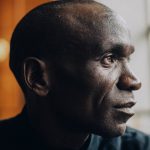
I haven’t followed the sport of running in recent years, but this morning’s profile of Eliud Kipchoge in The New York Times caught my eye and I was only too happy to have it interfere with my writing frustrations.

Eliud Kipchoge is the greatest marathoner ever. He broke a world record in Berlin this morning. 2:02.

The only running I ever did was running from my mother in my toddler days when I perfected the long distance sprint through our apartment. My sprint always culminated with a flop and slide on the cold linoleum floor of my bedroom and ended on the far wall beneath my bed, clinging to the galvanized springs.

Why reading about running?

Because: Massachusetts. Because: Boston. Because: Patriots Day. Because: Boston Marathon.

The Boston Marathon is always held on the Patriots Day holiday, and in Massachusetts Patriots Day is more about the marathon than Lexington and Concord.

It was also a school holiday. As a young teacher, I turned on the TV and listened to the marathon broadcast in the background as I hung out on my day off, half-listening to Heartbreak Hill but especially the final mile and the laurel wreaths. The rainy days, the hot days, the snow and sleet days. The we-run-no-matter-what-the-weather days.

Johnny Kelley, Bill Rodgers, Kathy Switzer. Dick and Rick Hoyt. Even Rosie Ruiz. The Tsarnaev‘s. We know the names. The successes and the failures. The inspiration and the shame.

Running is about challenging yourself and about endurance for the long haul. Same goes for being a writer. Some days you wonder why you’re still trying so hard. You think of all the books you could be reading, if you weren’t so engaged in the writing.

Eliud Kipchoge attributes his success to Patrick Sang, his mentor and coach, a relationship that began years ago.

Kipchoge:

“If I hadn’t met him, my life would be different.”

Sang explains it this way.

“When you’re young, you always hope that one day you’ll be somebody,” Sang said. “And in that journey, you need someone to hold you by the hand. It does not matter who that person is, so long as they believe that your dreams are valid. So for me, when you find a young person with a passion, don’t disappoint them. Give them a helping hand and see them grow.”

I think about persons past and present who represent the milestones in my life. Those who supported me, and those who didn’t. More important—I think about those I hoped to inspire.

As a teacher, I remember those faces, the ones who looked up to me with such enthusiasm as I passed out construction paper  and scissors from my art cart.

My students had many questions for me. They shared their fears and family secrets. So many questions asked so innocently.

Why me? What did I know? I hope it was because they knew I would always be truthful and worthy of their trust.

In retrospect, I have one regret. I wish I had hugged them. I wish I had given them big, squishy, “I believe in you” hugs. At that point in my life, I didn’t know the value of hugs. I had experienced only one significant hug in my life.

I was in the last stall in the darkest corner of the second floor girls’ lavatory when the heavy door to the hall swung open with a squeak. Quick, clattering footsteps crossed the tile floor. Searching footsteps, pausing, moving forward again. Sister Florentine’s voice rose above the chatter of the other eighth grade girls.
“Where’s Linda?” she asked.
What? Why? Questions formed between my worried eyes. I left the stall cautiously, its door swinging shut behind me, and dragged my feet down the dark aisle into the light streaming through the translucent glass blocks above the porcelain sinks.
Sister Florentine ran to me and enclosed me in her arms. The fire had been reported on the radio. Her wooden cross pressed against my chest and the woolen sleeves of her habit enclosed me in their folds.
I stiffened, unsure of how to respond.
Sister’s arms were wrapped tightly around me, squeezing and rocking as I stood stiffly in place.
It was my first hug.

When I feel down, I would love to have a dream in which I could see all of my students lined up in a row, the hundreds who have sat in my classrooms and made me feel special. I would remember the connection that we shared, and I would begin again.


on my way

Follow me on Facebook. (Thanks!)


Cancer, the Lesser of Two Evils

I have a friend—a fellow writer—who sold it all, packed up, and moved to a foreign country this year with her nearly blind 90-year-old mother and a little French poodle named Prose. Impressive, right?

Alison took it all step-by-step, sharing the ups and downs along the way with her Facebook followers and newsletter subscribers.  Mostly “ups” because what’s not to love about beautiful scenery, village life, starting over, and being inspired to write about it? And, living in the country where the subject of her historical novels takes place.

In a recent newsletter, she shared how she’s dealt with a series of recent “aggravations”.


1. Alison was robbed of her cellphone, wallet, charge cards, and their passports in one fell swoop.

2. The US Social Security system says that they overpaid her and now they want their money back.

3. Half of her newsletter subscribers were “unsubscribed” in one day by a glitch within the system of the very well-known newsletter service that she uses. Zap. Gone.


Being an eternal optimist, Alison focused on positive ways to dig out from under this mess without getting discouraged. She told herself these were merely aggravations. They weren’t real problems.

“Cancer is a real problem. Your house sliding down a hill is a real problem,” she wrote.

That got my attention.

“Cancer is a real problem.”  

But you know what? I’ve had cancer, and I’d rather have had cancer than those three “aggravations”.

Why? Because when I learned I had cancer, it felt like it was happening to someone else. My general practitioner gave me the news over the phone on the Monday after Thanksgiving.

“OK. What do I need to know? What do I do? What’s first? ” I responded.

I listened carefully, made a list, and proceeded to research the “who-what-where” that were going to help me.

After the research part, I was able to trust my decision and give the responsibility for the cure to my health providers. Done.

cancerI didn’t even cry. Not even once. Some people might think that’s not a healthy response, but for me, it was important to think of my cancer problem as something survivable by means of educated professionals doing the hard work while I lay there receiving the care—not quite like a guinea pig—but sort of.
It’s been six and a half months from diagnosis to completed healing.

A few days ago, my last open wound has sealed and healed.

Of course, it hasn’t been easy. Parts of this cancer stuff are a real bitch. I’m still fairly new to the place where I live, so I didn’t have a support system here. I spent a lot of time lying alone in my bed, waiting for sunset.

I love to read. I love to write. I had no motivation to do either. I couldn’t even enjoy watching Netflix, and I haven’t yet turned on the TV in 2018.

But still, if I had to deal with a robbery, a federal department screw-up, and a computer glitch with negative ramifications, I’m pretty sure I’d have taken to my bed, having a good long cry under the covers.

The difference between dealing with cancer and dealing with bureaucracy is that I would have had to deal with the bureaucratic issues all by myself.

Does any of this make sense?

I guess what I mean is that I never felt fearful or stressed about the cancer, but I’d feel very fearful and stressed if I had to make a lot of phone calls (I hate phone calls) and push a lot of sensitive paperwork to restore my life.

I know that Alison (Check out her website here: www.alisontaylorbrown.com) has probably gotten it all sorted out by now because she has an amazing attitude when faced with high seas.

She’s an inspiration, and that’s what we all need: inspiration from other people, showing us that if they can do it, we can do it, too. We may not be side by side, but we’re virtually together on this planet. At some point, we all need inspiration from someone like Alison to get us through the deep water.

I’m hoping for the water to recede soon.

Thanks for listening.


cancerDo me a favor?
How about “Liking” me on Facebook?
I do sincerely appreciate all the likes on my photos and posts, but the Like button under the cover image is the one that measures my writer page like-ability. Thanks!

Seasonal Blues: Eventually It All Comes Together

Except when it doesn’t. But hang in there—this isn’t a blog about pain and misery. It’s about life’s surprises.

When I was diagnosed with breast cancer in December 2017, I actually wasn’t too freaked out. My first response to my primary care physician, who was delivering the news from the other side of the country, was “OK. What do I do to fix this?”

We had the conversation about oncologists, surgeons, reconstruction and hospitals. A few days later, I returned home to Washington state and began the interviews, appointments, and education process. A lot to learn! A lot to take in, and more importantly, a lot to decide.

seasonal bluesFast forward to today. My first surgery is eight weeks behind me.

Where did the time go? It’s almost as if it never happened. Or maybe it happened to someone else. I did, very often, feel as though I was watching someone else’s life. Except for the long voids of empty space in time. The long period of not writing. All the blog posts that I never finished. The long period of doubts and fears and alone-ness (not loneliness).

My point is: when you’re in this situation, the one thing you realize is that you damn well need to get rid of anything that isn’t working because you only have this one life to live (that I know of in this current space in time) and you’d better make this current life the Best it can be.


Then, just when I could do the simple things that were forbidden for weeks—rolling onto my stomach in bed, enjoying a hot restorative bath, easing into a hot tub—doubts crept in.

Yesterday I was seriously— and I do mean SERIOUSLY—considering leaving this writing stuff to the next generation. Maybe, I thought, maybe I was meant to have more time for walking on the beach or binging Netflix. I’ve been reading Ann Patchett’s The Getaway Car: A Practical Memoir about Writing and Life, and I’m watching other parts of my life teetering on a seesaw each day.

I hadn’t re-read my manuscript since pre-diagnosis and yesterday was the day I was going to put aside the delays of the past three months, open Scrivener and see what was there. It was HARD. I did everything I could to avoid it, including walking 7,000 steps in the cold. (I’m on the other side of the country again.)

But then, after nervously consuming multiple items that were beyond a reasonable person’s calorie count for the day, I did it.

That is, I opened Scrivener and re-read Chapter One.

I found a couple of words that needed replacing because they echoed each other’s sounds in a non-complementary manner. I re-shaped the first two sentences to remove any triteness and draw the reader in. I was careful not to change anything just for the sake of changing it. Then, I renamed the chapter to reflect more depth of the content: From a blah “My First Memory” to a significant “A Fierce First Memory”.  In short, this three months absence from writing was beneficial. I’m back in the saddle.

Fierceness is my strength. Some people might call it stubborness, but, no, I say that it is fierceness. Tenacity. It’s what has had my back throughout these sixty-seven plus years. I can see now that “A Fierce First Memory” at age three is all about everything that would—and will—keep me together for the rest of my life.

I fell asleep feeling pretty good. Feeling as though I’m on the right track and able to assess the memoir content from a reader’s point of view.


This morning, if any doubts were lingering, I was surprised to greet three reinforcements from the Universe:

  1. A person I do not know, and who does not know my Polish heritage, was in touch with me, and she is from Poland.
  2. When I clicked on a New York Times article about tackling difficult challenges to self in one’s later years, I found that the subject was Polish and had much to say about tenacity. The article was a revelation for me because I only know the Polish-American point of view. Aleksander Doba reveals something I had not ever heard:

    “The more you don’t believe in Polish people, the more determined we are. To prove themselves, Polish people will endure everything. If you aren’t willing to suffer, you can do nothing. You can sit and die. This is the only one thing you can do.”

    Doba has a deep, almost performance-art-like sense of this. You can be made small by life or rage against it. “Nie chce byc malym szarym czlowiekiem,” he told me. “I do not want to be a little gray man.” This is a common expression in Poland — and a good motto for us all.        (*Dziękuję, Mr. Doba!)

  3. I had an email from John Guzlowski’s blog. He is a poet, a Polish Chicagoan whose Catholic parents survived Buchenwald. Until chancing upon his blog a couple years ago, I hadn’t even known that the Nazis had rounded up any non-Jews.

I accepted this trifecta of Polish-ness as a positive message because I rarely come in contact with much that touches on my heritage, so I am happy to acknowledge this as a happy accident of communications.

Seasonal Blues. Eventually It All does Come Together.


Follow me on Facebook.

*Thank you, Mr. Doba

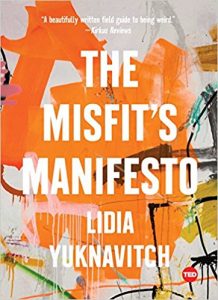
Misfits

Misfits are all around us, sitting next to us on trains, wrapped in sleeping bags on wet sidewalks in doorways of businesses darkened for the night, taking deep cleansing breaths on adjacent yoga mats, directing us in traffic, speaking to us from the fronts of classrooms, handing us change at cash registers, sipping a mug of coffee beside us, selecting a disk of perfectly matching matte makeup masking much. Glancing sideways at stop lights, ignoring the rain dripping inside collars, shivering, sweating, disguised, dark, diagnosed, undiagnosed.

Misfits probably maybe definitely usually hide themselves from the general public from their mothers from their fathers because they have to want to need to today tomorrow forever maybe.

Misfits walk with eyes shades drawn with minds scarred more than wrists than knees. They’ve fallen gotten up fallen again. And again. Again.


Misfits, if they’re fortunate, find a kindred spirit in their midst.

Lidia Yuknavitch is such a kindred spirit.

The Misfits Manifesto arrives October 24, 2017. Embrace it.


Lidia Yuknavitch will be speaking at Powell’s Books in Portland OR on 10/24/17.

She’s a wonder.

Lidia also has a TedTalk of the same name. View it here.


Like me on Facebook. Follow me. Thanks!

Maslow Meets Fear

Three days ago, I posted about the fear of tap dancing.

Well, there was a little more to it than that, but fear and hesitation pretty much sum it up.

Received an email newsletter this morning from Holstee, with its editorial written by one of Holstee’s two brother founders.

He referenced the psychologist Abraham Maslow as he spoke of a recent episode of his own fear, a backflip into a canal in Amsterdam. Do it. Don’t do it.

I had totally forgotten about Maslow (Psych 101). His theory is a perfect reference to the tap dancing post. That is:

Maslow said that at any given moment we can step forward into growth or step backward into safety.

It’s as simple as that.

If you choose growth over safety, it’s so worth it.

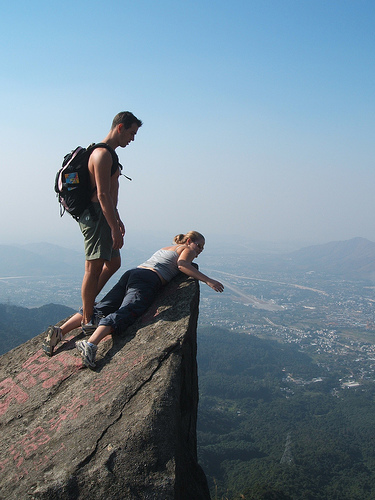
What’s your precipice?

fear


fear

Follow me on Facebook. I could use a few more friends. 😉

The Easy Way Out?

This summer, I’m taking a series of twelve tap dancing classes for adults at our local arts center. It was a last minute decision. I saw an ad in the local newspaper that triggered one my childhood desires.

Remember Shirley Temple and Bojangles tap dancing up and down that steep flight of stairs? Shirley’s banana curls bobbed up and down while the tails of Bojangles’ morning coat fluttered with the movement of his feet.

When I was five, I had the banana curls, but I never got the tap dancing lessons, so I thought, “Why not?”

The concentration required for tap dancing might be a good exercise for my brain, especially since I’m somewhat rhythm-challenged. Anyway, that was my excuse, and it turns out that tap dancing is a good brain exercise. Like rubbing your belly and patting your head at the same time.

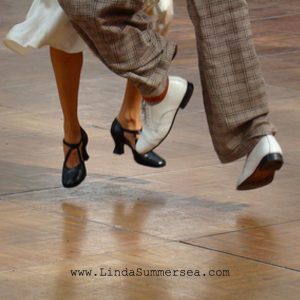
As soon as I registered for the class, I ordered my black tap dancing shoes. Amazon Prime.

And before the UPS man was even out of the driveway, I was lacing them on in the front hall. I walked across the tile floor. Click, clack, click, clack. Then across the hardwood. Click, clack, click, clack. Out the back door. Click, clack, click, clack. Across the wooden deck…

Suddenly I knew why those boys in junior high had cleats attached to the heels of their shoes. What a cool sound!

Our dance instructor says that tap dancing is making music with your feet.

I never thought of it that way, but now walking to the refrigerator for a handful of cherries has taken on new meaning. Suddenly it’s fun, clickety-clack, clickety-clack. Toe, toe, heel, heel. Stomp, step, brush, step.

As our instructor introduces new combinations of steps, I’m willing my feet to follow my brain, and soon I’m tapping a little faster, and faster still, as the lessons progress. I’m even managing to keep up with the midriff-baring, college-age females in the class. Just barely.

Our teacher says we’re doing really great and so she’s pushing ahead of the lesson plans.

That doesn’t stop me from having my doubts. I practice indoors and out with my tap dancing cheat sheet in one hand and my other hand extended  for balance. Toe, toe, heel, heel. Dig, spank, step, heel.

At home, without the distractions of ten other pairs of feet clacking next to me, and without the rafter-raising volume of Billie Jean pulsing to my core, I’m doing quite well. I’m surprising myself.

Then I set out for class and—like clockwork—about half way through the session, I get a wave of self doubt and my smile fades.

Am I ever going to be able to connect the movements on my own without someone calling out the steps? Maybe I shouldn’t have signed up for this. It was a dumb idea. How do four-year-olds even do this?

I’m going to tell the instructor that the tap dancing is stirring up an old knee injury. Or maybe I’m getting shin splints. I have a stomach ache. I have to be somewhere else. That’s it. I have an appointment that I forgot about.

Just as suddenly as the hesitation appears—every single week—I figuratively slap myself and carry on. I put the smile back, and concentrate harder. The music is fun, after all, and the clickity-clack feels good. And the sweat! The back of my neck doesn’t feel too pretty. Hot now. Summer in the city.

I realize that maybe it’s because tap dancing is not easy for me. I’m not in the habit of selecting really challenging activities as recreation. I know the things that I’m good at, and those are the things that have become my hobbies.  Isn’t the point of recreation to have fun?

This tap dancing thing is a good lesson for me. I’m showing myself that if I stick with something that’s not easy, maybe I’ll be better prepared mentally when I need to hang in there through a challenging life experience.

Clickety-clack. Brush, spank, hop, step. Dig, spank, step, heel.

And repeat.


tap dancing  Follow me on Facebook.tap dancing

Subscribe to my Blog. No spam. Your info never shared.

Meditation on One’s Calling

Clearly, for me, May has been a month of false starts and unfinished business, crossroads, and decision-making. Let’s try this blog post again. 🙂


Every Friday morning, I park my vehicle under a large Kwanzan cherry tree in a parking lot a couple blocks away from the Senior Center. With its fragrant double blossoms, it’s the kind of exemplary cherry tree that we associate with cherry blossom festivals in the Spring.

Two weeks ago its petals were drifting down to the pavement in flurries so thick it was accumulating like snow. Moist and slippery. And beautiful.

I was on my way to my weekly Guided Meditation Class.

I was thinking about earth—dirt, soil, compost, all of the above. I had spent a month that was more outdoors than in. I had been walking the earth, digging in the earth and thinking about digging in the earth, in the sun and in the shade, in the brutal heat and the cool rain.

#

I had begun April walking with Berber nomads from the desert plains to the Atlas mountains of Morocco, where the earth and the air were dry as toast. For a week, our international group of twelve were an active part of the nomadic experience 24/7.
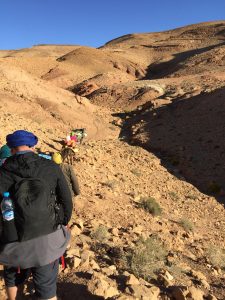
Atlas Mountains, Morocco, April 2017.


No running water save for one lively spring that poured  from a crack in the upthrust rocks on day 2. No conveniences of any sort, and millions—billions—of brilliant pinpricks of stars above by the time I slid into my sleeping bag in a new location each night. Intimately connected to the earth, with only the occasional bleating of sheep and goats breaking the silence.

When I returned, I spent a week transitioning back to modern life and crawling around in my damp gardens, thinning, transplanting, and weeding in preparation for another couple of weeks away in the outdoors.

I set out again, hiking the woods and hills in the Berkshires Mountains of western Massachusetts, enjoying “carpe diem” moments to continue the hiking momentum that had dominated my days in North Africa. Again, I hiked for hours without even noticing the time.

I found myself drawn to the trails where my literary heroes had walked, some of these trails now part of the Appalachian Trail. Went to the farm of Herman Melville and walked in his woods, climbing over fallen trees, and standing beside gardens that were still half-asleep after a long, stormy winter.

On one particularly unseasonably warm day, I climbed Monument Mountain where Melville and his friends had enjoyed these same views after a sweaty hike through mature deciduous woods scattered with the rocky remains of boulders tossed there during the Ice Age ten-thousand years ago.

Drove down to Amherst to Emily Dickinson’s home. Looked out the window from her second-floor bedroom, more gardens, more inspiration.

#

All of those experiences were uppermost in my mind on my way to meditation class that Friday morning.

Our theme that day: What do I have that I can share with the world?

We began with deep breaths in and deep breaths out. 4 seconds in, 4 seconds out. Belly breaths. By the time we reached the completion of our meditation, I was 8 seconds in, 11 seconds out. A new level of relaxation for me.

When I opened my eyes, I had my answer to the theme.

#

“Sharing my truth” is my answer. It’s been my goal for the past few years. I had dug deep into shrouded memories to write my childhood memoir after a long career as a teacher. I thought those years of teaching had (almost) been fruitless. I knew I had affected lives here and there, as most teachers do, and I had felt the reciprocal effects of my students’ lives as they taught me their life lessons. But teaching was not the career I had longed for as a child. I wanted to write, and it was a great relief when I realized later in life that it wasn’t too late.

#

Two days ago, our meditation theme was a variation on our earlier “sharing”.  What was “our purpose” or “our calling”in life?

Suddenly I remembered the words of a school principal during one of my annual job assessments. She told me that true teachers are born, not made, and that I was a natural-born teacher.

During Friday’s meditation, those words suddenly came back to me and I understood that all those years of teaching were not for naught.

I now see that there’s a connection between my previous life’s work and my current life’s work. With my writing, I hope to, want to, will continue to teach, but on a different scale and in a different format. No longer one to one, or one to thirty, writing has the ability to be one to infinity. As a writer, our work and inspiration can carry on long after we are gone.

What is your calling? your purpose?


meditating, meditation

Follow me on Facebook.

Sit With Us App

The Sit With Us app was announced yesterday, creating a subtle but ground-breaking way for lonely teens to connect in lunch rooms without calling attention to themselves.

16-year-old Natalie Hampton designed the Sit With Us smartphone application in response to the feelings that she experienced when she spent her entire 7th grade year eating lunch alone. The app invites students to become ambassadors and indicate their lunches are open for other students to join.

A brilliant idea.

If you’ve ever experienced lunch room loneliness, the news of the app may have hit you right in the middle of your aching stomach. The same stomach that felt really sick every single day as you slid your cafeteria tray down the stainless steel counter, dreading the end of the line, knowing that after you gave your fifty cents or dollar to the lunch lady, you’d have to pick up that tray and join the crowd whose roaring voices were filling your head with fear.

I was one of those kids.

I attended a parochial school in a neighboring town for grades K-8, and then, because my own town had a public junior high that went up to grade 9, I was forced to make my transition to public school there. After that, I transferred to a public high school back in the neighboring town again for grade 10-12.

I ate lunch alone every single day for those three years.

I can tell you the colors of the matching Bobbie Brooks sweater and skirt sets that the girls at the popular tables wore as I inched my way to a place by the window.  I remember their hair styles, their loud laughter, their Weejuns, their monogrammed sterling silver necklaces, their purses that held their rat-tailed teasing combs and packs of cigarettes. I can even tell you the conversations I overheard.

I did actually have a handful of friends—not at the same time, of course. But those friends had boyfriends or a lunch schedule that wasn’t the same as mine.

Every day my schedule placed me in the cafeteria at its busiest. By the time I lifted my tray from the counter and turned to face my fate, there were just a few single seats here and there.

The oak tables and chairs were lined up so close together that I had to lift my tray to shoulder height as I squeezed through the tight aisles. The sturdy old chairs had fifty years worth of bruises on their legs with lots of rough spots. They had seen a lot of abuse.

My goal each day was to carefully pick my way through the crowd to an empty space without getting a run in my nylons. About once a week, I failed. My stocking snagged on a splintered chair leg and I felt the hole in my stocking grow as its climbed up my leg leaving an ugly track of broken nylon and pale skin.

If I was lucky, my mother might have a spare pair of nylons at home but usually I had to wear the same stockings with the runs in them until she remembered to pick up a replacement.

We lived in a rural area of farms—no stores. I rode the school bus home and depended on my mother for the sundries of high school life. Nylons, binder paper and ball point pens.

It wasn’t so bad. I survived.

But the Sit With Us app would have helped.

sit with us app


sit with us appFollow me on Facebook.


Maybe you know someone who could use the Sit With Us app. It’s available as a download in App stores.

Sit With Us App