The Road to Marrakesh

After flights totaling 21 hours, we wearily checked into the El Mansour Hotel in the old Medina of Casablanca, Morocco. Roger left me in the dark shuttered room while he hailed a cab to pick up our rent-a-car. “I’ll be right back,” he said.

That was more than 40 years ago. February 1975. Our honeymoon.

Four hours later, my husband had not returned. I had taken two showers, paced back and forth endlessly, stripped off my clothes and burrowed deep into the downy bed, hoping to fall asleep and escape this nightmare.

I dressed and stepped out onto the balcony, shading my eyes from the brilliant sun that sparkled in the waves crashing on the Barbary Coast in the distance. Lorries and men in djellabas leading donkeys piled high with bundled goods vied for position in the street below. There was much crying and gnashing of teeth. Mine.

Finally, the brass doorknob turned. In strolled Roger, as though he’d just popped down to the lobby for a newspaper. An argument ensued. Roger claimed that some fellow had transported him all over the city because the car rental office was closed that day.

The next morning, he led me to a white Renault sedan and we headed north to Fez via Rabat. Roger was driving, although perhaps he might not have had the appropriate license. A young fellow, seeing our hippie clothing, had approached Roger earlier. Roger said the fellow would be our guide.

Distracted by this man in the backseat, Roger promptly zipped through an intersection, ignoring a traffic policeman’s directive to stop. Said policeman promptly signaled us to pull over. Our guide leaped from the back seat and ran away. I saw him growing smaller and smaller.

The policeman spoke no English. We certainly had no Arabic, and very limited French. The policeman commandeered a big-finned ’59 Chevy Impala and, as he climbed into the vehicle, he looked back, swiveling his wrist in a “follow me” gesture.

We traveled through narrow streets, finally emerging into a bustling square. An enormous pockmarked white stucco building stood at its edge. Unshaven men in dingy grey shirts stared out through barred openings.

The policeman, with starched uniform and stiff-brimmed cap, motioned out of the car. He brushed the street dust off his epaulettes, and adjusted the hem of his jacket. Throwing back his shoulders, he led us into the miserable building through a small cellar door.

There, across the vast, dirt-floored room, an enormous mahogany desk rose above us.

A ray of early morning sunlight shone through the single tiny window, and the polished surface of the desk reflected the somber faces standing in the long queue of derelicts beneath it.

A scowling magistrate peered down through wire-rimmed glasses. The policeman led us to the end of the line and as we inched forward, Roger formulated a plan.

“We’ll say that you’re ill from the heat. No—from your period! You have cramps! Hold your stomach. Moan!

When it was our turn, Roger pled “Ma femme est malade!”

A staccato conversation rose between the judge and the policeman. Suddenly the voice of the judge became louder– angry! What? The judge was reprimanding the policeman! Mon dieu! We just might get out of this.

The policeman led us back to the street, where he motioned that I was to drive. Roger hung his head, suitably shame-faced, and slid into the passenger seat. With an expression of disgust, the policeman waved me away from the curb. I shifted into first, then second, and pulled into a roundabout.

“Go!” he called, pointing north, “Go!”

Many kilometers later, we passed through Meknes and finally entered the capital city of Rabat. We were greeted by a traditionally garbed water-seller who poured cool water from his goatskin bag into shiny brass cups. We ate couscous in a café, then French pastries from a bakery. We were licking our fingers—rich strawberry tarts washed down with cold Oranginas.

Back in the car, we exited through the elaborately carved gates of the city, and soon were in the middle of nowhere, cruising along a smooth asphalt road that waved up and down, curving around orchards bright with oranges. The Atlas Mountains rose in the distance.

An argument ensued. Roger wanted to drive the car. “There’s no one here,” he contended. We quarreled for forty kilometers. Maybe more. I held my ground. He may have called me a “b*tch”. I may have said he was a “f*cking idiot.

Suddenly we heard a siren. It couldn’t be. It was. A motorcycle cop with a pen and ticket book in his hand. He spoke good English. He said that I had passed a donkey cart a while back in a “no passing” zone. Indeed, I had.

For a mere 200 dirhams (about US$50 at the time) we could put this little incident behind us. I peeled the bills from my wallet and smiled with appropriate humility.

At Fez, we hired a licensed guide who showed us his city with great pride and let me wear his fez for photos. We spent the night in a tiny hotel where the echoing Muslim call to prayer awakened us at dawn. We set out on the long road through the mountains to Marrakesh singing brightly. You know the song. “I’ve been saving all my money just to take you there, I smell the garden in your haairrr…”
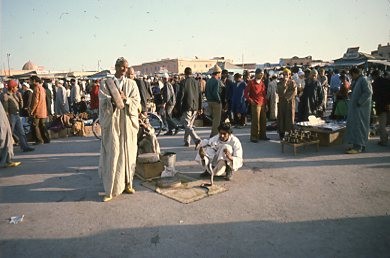
Cobra charmer, Djemaa El-Fna, Marrakesh; Linda Summersea photo

Cobra charmer, Djemaa El-Fna, Marrakesh; Linda Summersea photo

We found a room near Djemaa el Fna. A snake charmer removed his cobra from a coiled basket and led him in a hypnotic dance on a blanket. I practiced my negotiating skills, acquiring leather goods and djellabas from the vendors that surrounded the square.

It was time to head to Casablanca again, this time across the desert. Shimmering mirages appeared as a train steamed past us to the east. We rolled the windows down in the heat, singing “Marrakesh Express” at the top of our lungs.

Guess who was driving?
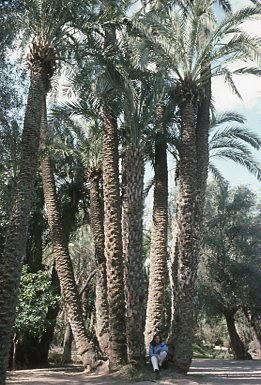
Linda Summersea, Marrakesh, 1975

Linda Summersea with Palms, Marrakesh, 1975


What Do You Give A Man Who Has Nothing?

Today is the 80th birthday of His Holiness the Dalai Lama of Tibet.

I am honored to say that my article— What Do You Give To a Man Who Has Nothing? —has just been published on elephantjournal.com.

………………………

What Do You Give a Man Who Have Nothing?

The Wall St. Journal had an article on Friday that I thought was going to address gift-giving for the 80th birthday of the Dalai Lama, but it turned out to mostly be about cake. (Everyone from the Glastonbury Music Festival to the Art Institute of California-Orange County has been baking birthday cakes for His Holiness.)

The article mentioned the Dalai Lama’s selflessness and his habit of re-gifting, but mainly, it presented material examples—not spiritual, as I had hoped.

So—in honor of the Dalai Lama’s supreme selflessness, I suggest that we bestow upon him a birthday gift of our attention to Buddhist principles. Let’s try to send so many positive, loving thought waves throughout the universe today that the planet will literally vibrate with our intentions.

The following is my list of Dalai Lama quotes and 10 suggested gifts.

  1. “Depend on Mindfulness.” ~ Dalai Lama.

Today, let’s give mindful attention to all of our daily tasks from the trivial to significant.
One way that we can focus on this is to take three deep breathes when we switch gears—before we enter the shower in the morning, before we cook our breakfast, before we eat our breakfast, and so on. Mindfulness: a simple concept, but a challenging habit to adopt. Let’s be especially mindful during today’s yoga class.

  1. “Love and compassion are necessities, not luxuries. Without them, humanity cannot survive.” ~ Dalai Lama

Love and compassion are main components of Buddhism’s bodhichitta a path to enlightenment with many facets.

In Pema Chodron’s book The Places That Scare You, bodhichitta is described as as “a soft spot, a place as vulnerable and tender as an open wound”. Let’s seek our own soft spot today, sharing love and giving compassion by understanding another’s pain.

  1. “Remember that the best relationship is one in which your love for each other exceeds your need for each other.” ~ Dalai Lama

Speaking from experience, I believe that our first encounters with love often develop into relationships where there is an imbalance of need and want. This creates weakness in the relationship, leading to failure. We should not need one another, but want to share our love. Let’s try to be less needy today.

  1. “Silence is sometimes the best answer.” ~ Dalai Lama

Who among us cannot contribute a little silence? This is a great gift.

  1. “Be kind whenever possible. It is always possible.” ~ Dalai Lama

There are daily challenges to our kindness, not the least of which is our own impatience with brief acts that inspire negativity. The person that cuts us off in traffic. The waitperson that accidentally spills coffee on our sleeve. The child that has left their toys out.

Let’s be kind, and in return, it will foster kindness in those we touch.

  1. “We are born and reborn countless number of times, and it is possible that each being has been our parent at one time or another. Therefore, it is likely that all beings in this universe have familial connections.” ~ Dalai Lama

Treat everyone if they are our brothers and sisters. Our familial relationships have their ups and downs, but usually, we are more willing to make peace with our brothers and sisters than with strangers. Let’s sincerely try to extend that respect to all.

  1. “A vegetarian diet is the most healthy one for you. We must respect all forms of life.” ~ Dalai Lama

The Dalai Lama is not strictly vegetarian, as he lives also by the principle that he should accept whatever he receives, but he also believes “Animals deserve our compassion. We must know their pain. We should nurture this compassion through education. Showing concern about animal rights is respecting their life.”

Let’s prepare and enjoy a lovely vegetarian meal in his honor.

  1. “Happiness is not something ready made. It comes from your own actions.” ~ Dalai Lama

Happiness. This is a tough one. We can appear so free and balanced in others eye, yet often we lack true happiness. Let’s try not to measure our lives against another person’s measuring stick. Let’s try to have a truly “glass half full” attitude towards life. It will make us happier.

  1. “Take into account that great love and great achievements involve great risk.” ~ Dalai Lama

In 1989, the Dalai Lama was awarded the Nobel Peace Prize for his work advocating nonviolent means to free Tibet from China. It’s not always easy to take the leap of faith towards love, and it’s not always easy to have faith in one’s goals. Take a chance on love and life today. Take the risk and find your own inner peace.

  1. Fasting.

The Dalai Lama usually has hot porridge for breakfast with barley powder, hot tea, bread and jam. A vegetarian lunch, and no dinner. I have read that as celebrations of the His Holiness’ 80th birthday take place around the world, some celebrants are including fasting in varying degrees.

Surely, if the Dalai Lama can forego dinner on a daily basis, we can go without dinner tonight in accordance with his practice.

Maybe we’ll find that we can do without more than we thought.

Happy Birthday, His Holiness Dalai Lama!

In honor of His Holiness, let’s have an awesome mindful day today!

I’m heading out to yoga class in 30 minutes… how appropriate.

……………………………

Click here to read the article on elephantjournal.


Photo credit: Tenzin Gyatso

Photo credit: Tenzin Gyatso


Finding Bodhichitta. Finding Love.

(Author’s Note, after the fact: I just counted 5 “fears”, 1 “fearless” and 5 “loves” in this post. You can’t have too much love, but 5 fears is crazy. This is not one of my better pieces.)

I’ve been reading Buddhist beliefs lately, not in search of a new religion, but as a willing student of world thought.

I was raised in a religion filled with ritual, fear, and dark-robed teachers. As a chronically depressed child, I didn’t need any more fear in my life but I hung with the sheep until my escape to college. I can definitely say that there was zero love in my life so I had no role models in the treatment of other people and animals. For me, life was pretty much about treading water and survival.

Navigating my adult years with highs and lows, I married, had children, moved about a bit, and experienced a life of rich creativity—without feeling any sense of accomplishment or joy from it.

I never spent much time thinking about religious doctrine, but I knew that I believed in karma.

I loved my children and my students. They shared so much with me—fearlessly.

I was too busy to think about Todays. (I was busy thinking about Yesterdays and Tomorrows.)

Like many people, I’m finding that as I look in the rearview mirror and see the end of life on this planet, I have a lot of questions.

I picked up Pema Chodron’s The Places that We Fear because Fear has always been such a huge part of my life. I’ve been dogged by the shadow of fears that were branded upon me as a child for so long that it seemed as if that’s all that Life was about.

Every morning for years, I awakened with a sense of impending doom that I shook off with a couple cups of coffee before heading out into the Light.

I was surprised to learn that bodhichitta is not a heavy-duty doctrine.

Surprise. It’s about Love.

Doesn’t everyone want more Love in his life?

In reading Chodron’s work, I see that, of course, it begins with my attention to the Love around me. And Compassion. In bodhichitta, we have the ability to feel the pain that we share with others.

Chondron says that “sometimes the open heart and mind of bodhichitta is called the soft spot, a place as tender as an open wound. It is in part equated with the ability to love.”

It’s a way to enlightenment.

Maybe

“In every heart there is a room
A sanctuary safe and strong…

Maybe

“…And this is why my eyes are closed
It’s just as well for all I’ve seen
And so it goes, and so it goes

And you’re the only one who knows.”