My Victory Garden 1979

For those of you who remember PBS’s Victory Garden: It was originally Crockett’s Victory Garden.

From the WGBH Archives:

“Hosted by James Underwood Crockett, the series offered practical advice on vegetable and flower gardening and the latest in horticultural developments. It began airing locally April 16, 1975 and premiered nationally on PBS April 7, 1976. The series was hosted by Jim Crockett until his death in 1979. The series was then renamed The Victory Garden.”

I had gardened continuously ever since I was a child on the farm, walking down the rows of freshly planted potatoes. One of my siblings dropped the potato cutting into the trench, my mother covered the potato with soil, and I stomped on the soil to pack it down. Long rows of potatoes resulted in 2 or 3 full-size wooden steel-belted barrels in our dirt-floored cellar for winter.

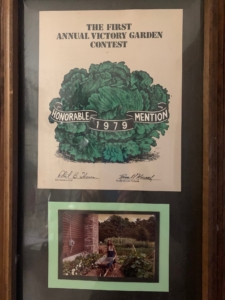
Dirt was permanently beneath my fingernails, so when Boston’s WGBH had a “First Annual Victory Garden” contest in 1979, I was excited to enter my garden photo.

At age 29., I was thrilled to receive an Honorable Mention. My framed award and the winning photo of me in my Massachusetts garden that year have traveled with me for the last 48 years.


Earth Day 2018

Earth Day 2018

Coffee. Walnuts, banana, cheddar cheese. Journal. Coffee. Email. Coffee. Coffee. Feed pets.

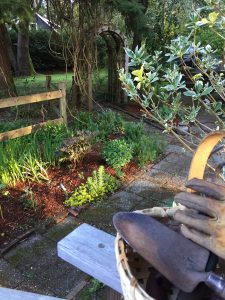
Gardening trousers, wooly socks, Black Dog t-shirt, 20+year-old Coolibar hat, ancient Merrills. leather gloves. Basket, trowel, hand fork, weeder, wheel barrow, kneeler.

Kneel, dig, pull, gather, worm, smile, sun. Move, dig, pull, gather, smile. Greenhouse, bonemeal, potash, pour. Garden, bonemeal, potash, sprinkle, rake. Mulch. Water.

Kneel, dig, pull, gather. Repeat. Repeat. Repeat. Repeat. Repeat. Repeat. Repeat. Repeat. Dump wheelbarrow.

Kneel, dig, pull, gather. Repeat. Repeat. Repeat. Repeat. Bonemeal, Potash. Rake. Mulch. Water. Repeat. Repeat. Repeat. Repeat. Dump wheelbarrow.

Irrigation pipe. Connector broken. Male+Male connector.

Earth Day 2018 Recycle Event. Long line. Drop off dead TV. Smile.

Farmers Market. Donut. “Early Girl” tomato plants. Smile.

Garden center. More mulch. Male+Male connector. Check.

Irrigation pipe. Male+Male connector. Wrong. Hmm. Frown.

Garden center. Exchange Male+Male connector.

Irrigation pipe. Male+Male connector. Right. Check. Turn on water. Success. Turn off water.

Kneel, dig, pull, gather. Repeat. Repeat. Repeat. Repeat. Repeat. Repeat. Repeat. Repeat. Dump wheelbarrow.

Greenhouse. Fish fertilizer. Raised Bed. Dig holes. Bonemeal, fertilizer, potash. Tomato Plants. Mulch. Water. Garden Journal.

Porch. Shoes Off. Kitchen. Refrigerator. Leftovers. Water. Water. Water. Aleve.

Fir cones, storm branches, wheel barrow. Dump. Clouds, Rain.

Kneel, dig, pull, gather. Repeat. Repeat. Repeat. Mulch. Repeat. More rain. Repeat. Repeat. Repeat. Repeat. Dump wheelbarrow. Sun.

Fence repair. Check. Replace section.

Drainage troubleshoot. Pencil, paper. Check. Aleve.

Rock wall analysis. Move slates. Dry wall, think, design. Smile.

Peel trousers, shirts, socks, shoes. Hot tub. Sigh. Float. Sink. Sun. Trees, blossoms, birds.

Shower, shampoo.

Sofa, cheese, wine. The Grave’s a Fine and Private Place, Alan Bradley. 5 pages. Doze. 2 pages. Doze.

Leftovers, email, NY Times crossword.

Alan Bradley. Doze.

Journal. Bed. Read. Doze. Lights out.

6,884 Steps.

Earth Day 2018.


Linda Summersea Follow me on Facebook.

seasonal blueThanks!

Anticipation. In the garden and in Life.

I’ve been watching the fruit and vegetables in the garden grow and mature. Weeding, watering and wondering. When exactly is the first tomato going to be perfectly ripe for the picking?

Anticipation, I’ve always said, is a big part of any experience whether it be harvest or travel or concert or film or other highly anticipated event. The days creep along, the calendar dates change slowly. Finally, the day arrives.

Last week, a few tomatoes began to ripen in earnest. Pale orange became pale pink became reddish became almost red but not quite true ripe juicy red. I wandered around the plants, lifting a leaf here and there. I wondered which tomato would be first.

The Early Girl plants are massive, the Jet Stars half their size. Pacific Potager, where I bought plants this year, had at least three dozen varieties of tomato plants to choose from. This being only my third summer in the Pacific Northwest, I was uncertain of which to try, so reliable Early Girl was my first choice. I chose Jet Star plants because they were sturdy with a maturity date several days beyond than the Early Girls.

Surprisingly, when it came right down to it on Thursday afternoon, it was a Jet Star that would prevail.

I was harvesting parsley in the shade of our wisteria-covered pergola. Had pulled up the plants, roots and all. Rinsed off the roots with the garden hose and was snipping the parsley off the stems into a tub in preparation for chopping in the food processor before filing away in the freezer.

After a half hour of snipping, I was ready for a snack and remembered that it might be time for First Tomato.

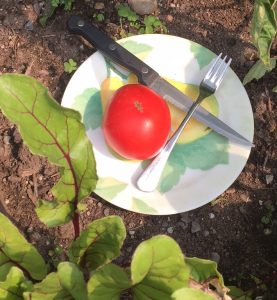
A few steps away, there she was. Bright red, perfectly red and ready. I tenderly removed the tomato and placed it on a plate. “Tenderly”?

Yes. This was no grocery store tomato, not even a farmer’s market tomato, but a tomato to be consumed in the garden, minutes after picking.

Returning to the pergola table, I slowly drew my knife through its center, the fruit yielding perfectly to the bite of the serrated blade. I cut again, and again, until the tomato lay before me in perfect bite-sized unadorned fragments. Twenty of them. I took the time to count.

Is this beginning to sound obsessive-compulsive?

It was pure anticipation and enjoyment and I was delaying consumption as long as I could.

I sprinkled black pepper and then ground a few twists of pink Himalayan salt, watching the salt dissolve as it landed on the wet surfaces.

Then, the fork. The first taste, the flavor.

Jet Star Tomato

First tomato of the season

I spent a good fifteen minutes enjoying that tomato, while thinking about how I need to cherish more moments like this with pure anticipation and enjoyment.

What’s your tomato today?


Follow me on Facebook.

The Time is Ripe.


Writing in the Garden

After two weeks of getting the gardens back in shape, I finally climbed down from the ladder and removed my deerskin gloves. I stood back to admire the roses I had just pruned, gathered up my tools and peeled off the extra layer of denim that does a superb job of protecting one from thorns while having a full body immersion in rosa floribunda “Lime Sublime”.

That morning I had crawled around in the shade of a respected Douglas Fir, tidied the copper bird bath and plucked a couple hundred weeds that were hiding behind a wall of Digitalis purpurea. Common foxglove is labeled an invasive species here in Washington but I let it enjoy grandfathered perennial status in my garden. Who can resist gorgeous, long-lasting spires that are happy to fill in the blanks before a backdrop of charcoal stone walls?

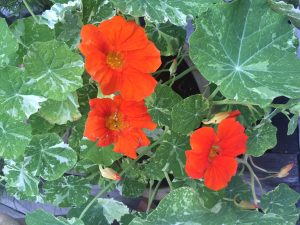
Every empty pot from the greenhouse was now refreshed and blooming plentifully. The two packets of nasturtiums that I had picked up half-heartedly from the rack at Thriftway have become the surprise stars of the garden. They never grew very well in my other gardens, but they’re loving it here—as I am.

Nasturtiums have been my favorite trawritingiling annual, ever since stepping from the street into the bright inner courtyard of the Isabella Stewart Gardner Museum nearly fifty years ago. Their variegated foliage dotted with brilliant orange and lemon-colored blooms hung in a curtain twenty or thirty feet from the fourth floor window boxes of Mrs. Gardner’s living quarters.

I had a boyfriend who was Henry Higgins to my Eliza Doolittle. I was a naive farm girl and he, a tweed-jacketed student at a private men’s college. He introduced me to the Gardner Museum on The Fens in Boston, took me to dinner at La Petite Auberge and presented me with bouquets of fragrant flowers that filled the elevator with their heady scent as we rode up to the 8th floor of my dormitory amidst the envious sidelong glances of other bell-bottomed young women.


At home, we never had flowers on the table. With the exception of Mummy’s favorite lilacs in June, Daddy wouldn’t allow it. He said that florist flowers reminded him of funeral homes. Leave it to him to find evil and sadness in soft-petaled Stargazer lilies and pendulous snapdragons.

But my love of flowers grew as tall as the roses on my arbors. Here in coastal Washington, many of the plants are foreign to me. There are lots of new Latin names to learn and growth patterns to observe.

Best of all, while I’m dead-heading lilies or untangling clematis, my mind can wander freely. While raking up the fir cones after a storm, I can leaf through ideas for future writing. While cutting lavender to weave lavender wands for my dresser drawers, I can harvest ideas for an essay.

And sometimes, I’m able to encourage new growth by thinning out a chapter that I’m not a hundred per cent pleased with.

A little pruning, a little staking. Companion planting of subjects and objects. Like walking the rows in a landscape nursery, I enjoy searching for the perfect verb to complement a noun.

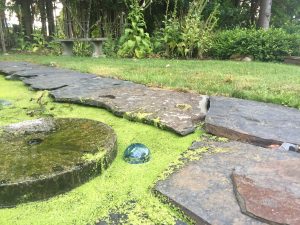
While kneeling at the edge of the lily pond and reaching to remove some fallen leaves, I see my reflection in a gmillstonelass orb floating on the surface.

I’m no longer that young Eliza Dolittle, but I still have a lot to learn.


writing Follow me on Facebook.

Dirt Paths

I had a dirt path epiphany this week. A grounding, as it were.

We moved to this mostly paved, though very rural, island nine months ago. Previously, we lived an isolated 45-miles-from-a-decent-grocery-store, dirt road lifestyle on a lake in the Ozarks.

Now that we’ve been here for nine months, a period equal to full term human gestation, I’ve come to  realize that I’ve been missing a critical element in my personal human needs. After nine months “in island utero” I found that I was getting downright snappish.

It wasn’t the isolation from the mainland. I like the fact that we’re an island of mostly kindred spirits with a population kept reasonably low by the lack of a bridge.

It wasn’t for lack of solitude. I replenish my need for reflection with long solo walks on the beach almost daily.

It wasn’t for lack of physical activity. Yoga and aqua aerobics give me more of that than I’ve had in the past twenty years. Or, even human contact. I’ve met a few people, but this isn’t about human connection. That’s another story altogether.

I entered the island forest last week, looking for a change from the beach. I hadn’t walked in the forest since April. As I headed into the woods, I remembered that, once inside, all sound of the outside world is masked in silence.

I could hear leaves falling and the flutter of wings. I could feel my heart rustling and swelling and, believe me, it’s been a long while since I’ve felt my heart rustling and swelling.

With each footstep deeper into the forest, I found myself fondling the tender spot that resides deep inside my psyche. I was surrounded by an atmosphere of hypersensitivity.

Even my dog, Lily, seemed to get it. She bounced along beside me, both of us practically floating. Rich humus absorbed our steps, decades of soft organic soil. No echoes. No distractions. Just absorption.

Connection to the earth is not to be underestimated. Farmers know this. Gardeners know this.

All I want to say is that feeling the earth, walking on it, lying down upon it, digging in it, kneeling low to the ground is restorative.

Since I had just finished a huge writing project this week, I returned to the forest the next day for more of the same. I was also able to head out to my garden this morning and devote three hours to the sweaty task of digging, pruning and weeding.

There in the garden I found myself experiencing more of the same grounding that I felt in the forest—and that led to this blog post. If you’ve read this far, perhaps you’ll forgive me this brief bit of touchy-feeling. I needed to remind myself of the value of a true earth connection.

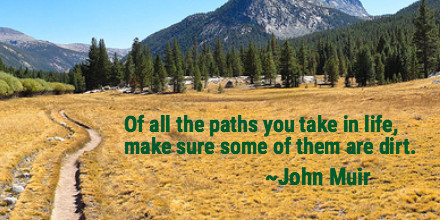
“Of all the paths you take in life, make sure some of them are dirt.” John Muir

John Muir dirt paths

Live the Island Life: Live Green. 10 Tips Learned from Island Living.

I confess that I am in the midst of a very long, ongoing love affair—with islands.

Many islands. I have yielded to their temptation in many seas—some repeatedly—and each island has shared its unique characteristics abundantly and unabashedly.

The most valued aspect of these island affairs is that they have taught me the principles of green living, as dictated by the isolation that is a normal, accepted part of the island lifestyle. While the isolation is part of the charm, it also has its own set of challenges.

The point is that living on any island requires one to live mindfully. Mindful of everything from water use to recycling to consolidating trips to the mainland to save money.

Right from the beginning, I found myself constantly saying, “When we return home, we need to continue to live as though we’re living on an island.”

And then we did.

Here are a few things we learned.

  1. Avoid paper products. Paper products take a high toll in trees and are bulky to ship to islands. We had never used paper products except for toilet paper, so this was easy. One amusing result was that when our oldest son went to Kindergarten in 1985, he returned home with cafeteria questions.

“What are those paper squares that the ladies put on the trays?” he asked.

“What do they look like?”

“They’re folded up,” he said. “They’re white.”

“Ohhh. Those are ‘paper napkins’. Schools don’t use cloth napkins,” I said.

I imagine the school staff thought we were raising little heathens who didn’t know how to use napkins.

  1. Conserve water. On the islands that we have visited, water is usually gathered from the passing rain showers and saved in a cistern. You didn’t let the water run while you brushed your teeth. You didn’t run the washing machine without a full load. Common sense.
  1. Don’t get hung up watching television. In the islands, mega-sized generators that fueled the entire island and went down several times a day often supplied electricity. Televisions were rare. One time walking the dusty road into town, I saw a crowd gathered around a tiny black and white set in front of a village store. The crowd was laughing hysterically. I approached to see Paul Rodriguez beaming in from Mexico City. We rarely watched television, and this non-habit was part of our life at home. While we had a television—a small Sony that we had purchased in 1974—we only watched it for occasional news or—ha!—“Saturday Night Live”.

Instead of watching television, we sat out on the porch. We read, or played Scrabble, or talked to each other. Sometimes we swung in the swing under the shade of the enormous twin beech in the front yard. The boys rode their tricycles up and down the length of the porch, and chased fireflies at dusk.

In later years, we would occasionally rent a movie from the convenience store. In those days, when you rented a movie it entailed carrying home a VCR unit. Yes, kids, you carried home a VCR and a VHS movie videotape as part of your evening rental, hooked it up and then carried back the whole kit and kaboodle the next morning.

  1. Visit your library for reading materials. I loved one island’s aged library whose wide stone sills had been built during the sugar mill days. At home, instead of buying books impulsively, we went to the library. I did have a small but growing library of my own beloved titles, and we did buy Children’s Books. I wanted our sons to know the joy of having special, favorite books. Going to the bookstore was a very dear activity. When they moved from home, our sons took with them several large boxes of their childhood books, which they retain today in their 30s.
  1. Buy local. In the islands, you can’t get there from here. You have to be satisfied with what’s available from a limited selection. Once when I asked for a Hershey bar at an island mini-mart, the response was “melt too much”. (The heat also makes the language terse. 5a. Mean what you say and don’t chatter needlessly.)

At home, we didn’t just drive into town for every little item that we needed. No impulse driving. We kept a list for the items to be purchased and the errands to be run. In later years, when we lived in a rather remote location by some standards—an hour’s drive from the grocery store—our habit served us well.

  1. Grow a garden and cook it yourself. In the islands, local produce is king. Due to the high cost of ocean freight, in the islands you pay high prices for prepared foods that mainlanders take for granted. At home, I planted and maintained a garden from Day 1. Organic. In the early years we lived close enough to the ocean that we used seaweed to mulch and enhance our soil. I canned and froze everything. At home, we cooked from scratch. Everything. Even the bread—and this was before bread machines. As a result, our children enjoyed nourishing food and were never fussy eaters.

There were some times when it proved comical.

Our children always chose a favorite meal for their birthday dinner. One year when our youngest was five, we had a birthday party and four little boys joined us that evening. Zack’s selection was a Cantonese meal: Ho Yu Gai Poo. The children refused to eat it. No problem. We had lots of leftovers. I suppose I could have told them that these were “chicken nuggets” and served the sauce on the side, but I’m glad that this didn’t enter my mind.

When our sons grew up, their taste buds were “spoiled”. Since they had never experienced fast food, they didn’t crave it. Of course, they did try it when they went away to school, and certainly ate it for a period of time. Now in their 30s, our sons favor a plant-based diet with occasional free-range meats—never pork. (Pigs are smart creatures.) They have been at times vegan and pescatarian. It makes a mother proud.

  1. Make things and fix things. In the islands, you don’t buy new clothing every season, as the fashion magazines would lead you to believe is necessary. If you need a chicken coop, you build it. Recycled lumber is very common.

I had always sewn my own clothes, except for blue jeans and imported Indian tops and winter jackets.

I had always been repulsed by the pinks and blues assigned at birth so automatically. I made velour overalls for our babies, soft and warm, and in bright or earthy colors like purple and russet. I hand-sewed a stack of quilts, made a goosedown coverlet from a Colorado kit company, and knit a cedar closet full of woolen sweaters. We built our own house, barn and chicken coop. For heavens sake, we drilled our own well!

Sometimes when I think back, I have to remind myself that this all really did take place. I’m sure that some of you can identify with this. There is nothing quite like the energy of youth. Youthful energy becomes mid-life habit and mid-life habit begets senior citizen tradition. It’s all good.

  1. Find delight in nature. In the islands, we enjoyed tropical trails and white sand coves on shore, and coral canyons full of schools of bar jacks and butterfly fish in the sea. At home, we looked forward to morel mushroom season in the woods when we walked sycamore-lined creek beds and old apple orchards. I followed the tracks of a mountain lion and her cubs with my snowshoes, reveled in the sound of the coyotes in the hills, and absolutely loved to watch the beaver heading home at dawn as he swam across the front of our property. Admittedly, we had to wire fence our trees to ward him off. One morning, I found an otter lazing about on our dock eating fresh water clams.
  1. Dream about the rest of this amazing solar system. One island home that we rented had a flat concrete rooftop where lounge chairs called to you at night so that you could view Mercury on the horizon in December and watch for the occasional shooting star—a special treat to point at quickly and track across the sky.

At home, I drove the truck up to a high field during the Perseids in July and lay in the truck bed with my sons while the cascades of meteors flew by.

  1. Share with your friends and neighbors. In the islands, little is wasted. We saw people carrying home other persons’ discards. At home, if we didn’t need something, we sold it cheaply or gave it away to someone who did. The boys sorted through their toys for donations, and participated in food drives.

I’m pleased to say that we now live on an island in Puget Sound where these values are firmly in place. People here take the ferry to the mainland. Thankfully, there is no bridge.

Certainly we haven’t spurned technology. It brings the world to us. We even have an island Facebook group where our residents share what they no longer need, report ISO (in search of) items and report stuff we need to know. Example:

“Heads up! Two Nubian goats seen headed south on Island Road at 5:10 this afternoon. Do you know who they belong to?”

I am very pleased that we are living the island life in reality now, but then, we have always lived the island life.

Live the Island Life Anywhere on the Planet. Live Green.
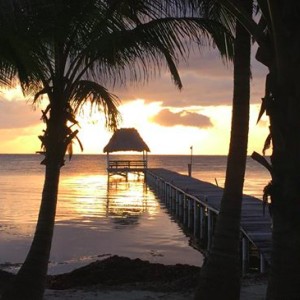
live the island life

live the island life Follow Linda Summersea on Facebook.