Sankofa: Go Back and Fetch It

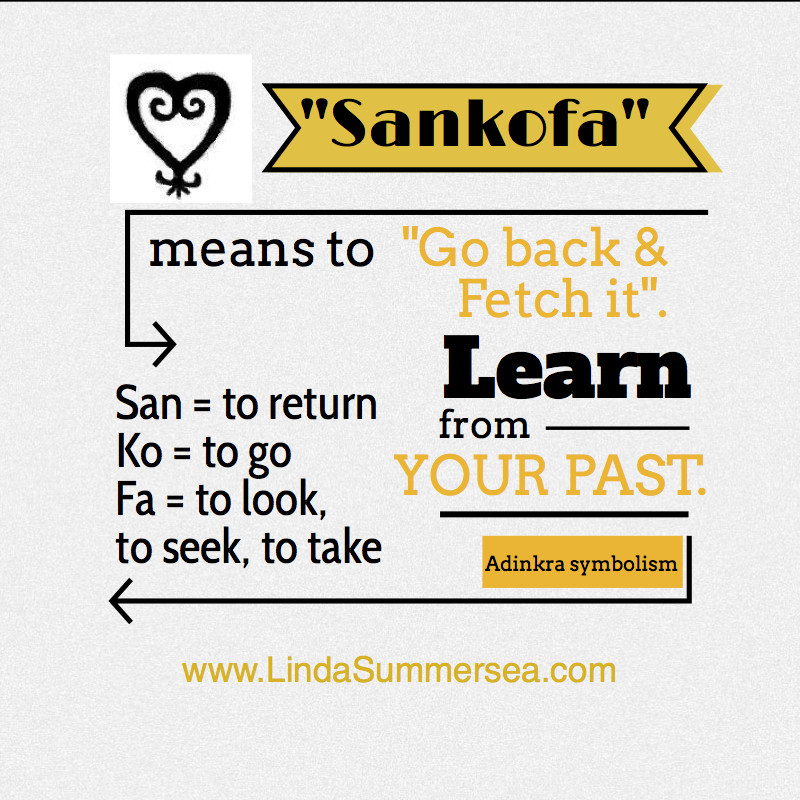
AdinkraSankofaNot too many years ago, when I was teaching Adinkra symbolism to children in the Arkansas Delta, there was a symbol that caught my attention with its graceful design, and caught my heart with its meaning. The symbol was “Sankofa”, a stylized heart with a curvy inside and base. It became my mantra and my life symbol.

The word “Sankofa” in the Adinkra language means “Go back and fetch it”. It emphasizes the necessity of learning from the past before one can move forward.

“Sankofa” means that we must go back and reclaim our past. Take ownership of it. Review what took place and try to come to terms with our role in the past- whether as victim or oppressor. Only then can we understand why and how we came to be who we are today.

Sankofa is particularly relevant to the emotional work that must be carried out by those like myself, who have written a memoir with less than pretty details.

There’s much to be scrutinized and evaluated- and then, either tossed or taken. When you keep Sankofa in mind, hopefully, like me, you can find enough positive growth in the hardships to enable forgiveness for the harms done to you.

Your past is not my past and my past is not yours- but our history does not have to be similar to be shared. We need only to be able to have empathy for another’s experiences, and realize that the past will always influence our future.

Go back and look, seek, and take. Take away the Truth and carry it to the Present. Learn, so that you don’t make the same mistakes. Learn, so that you can duplicate the positives. Love and prosper.
sankofaSummmersea

I Spent Many Happy Hours in the Cemetery, Fantasizing about Death

Throughout my childhood, I was crazy obsessed with Death. The nuns spoke fondly of Death as such a lovely place… joining the saints and our Father in heaven… It’s no wonder that I prayed every day that I would die and go there… where everything was perfect and I would be able to lie in the billowy clouds for as long as I wished, with no one calling me to come home.

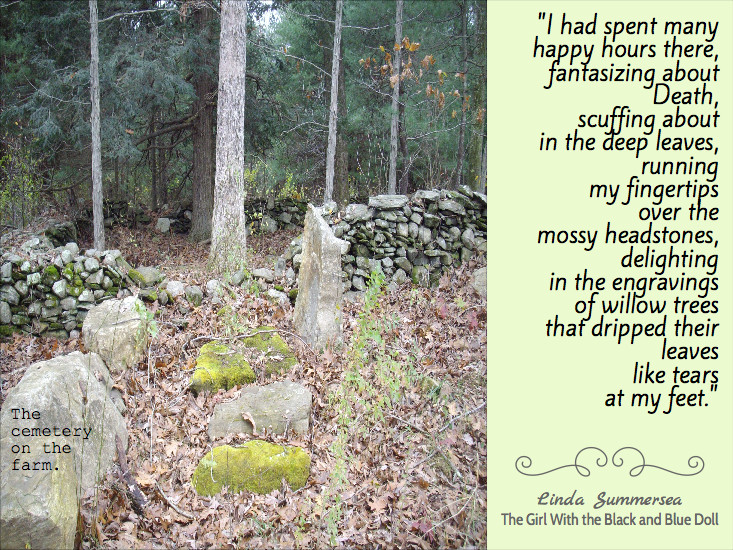
The cemetery on the farm, it seemed to me, was as good a place as any to prepare for my dispatch to the great beyond.

“I had spent many happy hours there, fantasizing about Death, scuffing about in the deep leaves, running my fingertips over the mossy headstones, delighting in the engravings of willow trees that dripped their leaves like tears at my feet.”

from The Girl with the Black and Blue Doll, A Memoir of Childhood Depression.

cemetery

In the Shadows

In my travels over the hundred acres of the farm and its outbuildings, I spent a lot of time observing my surroundings. Much of the time, I was alone and so unspoken communications with wildlife encouraged me to wonder about our capacity to understand each other.

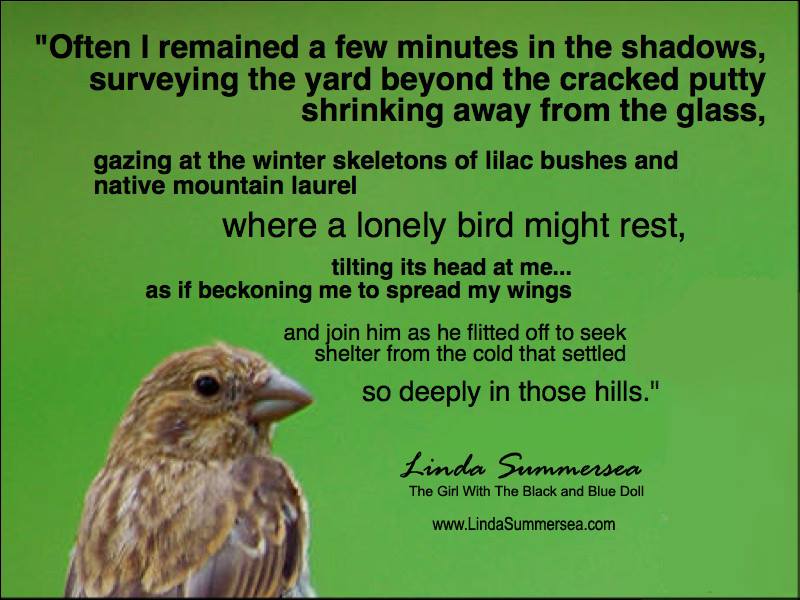
“Often I remained a few minutes in the shadows, surveying the yard beyond the cracked putty shrinking away from the glass, gazing at the winter skeletons of lilac bushes and native mountain laurel where a lonely bird might rest, tilting its head at me… as if beckoning me to spread my wings and join him as he flitted off to seek shelter from the cold that settled so deeply in those hills.”

from The Girl With the Black and Blue Doll, A Memoir of Childhood Depression


Maya Angelou, on growing up.

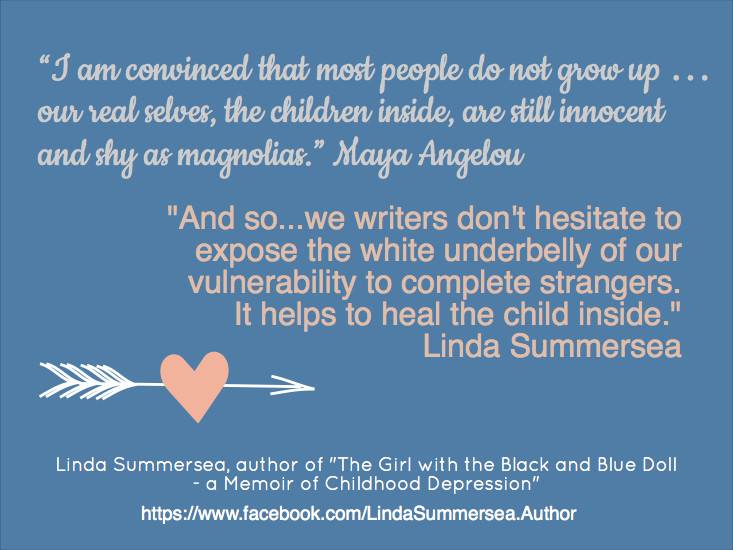
Maya Angelou said, “I’m convinced that most people do not grow up… our real selves, the children inside, are still innocent and shy as magnolias.”

I certainly identify with her statement, and was very surprised to see that one with such a bigger than life persona- Maya Angelou- felt that way.  But I do feel that it somewhat explains why we, as writers, have little hesitation to expose the white underbelly of our vulnerability to complete strangers. It helps to heal the child inside.

maya angelou